

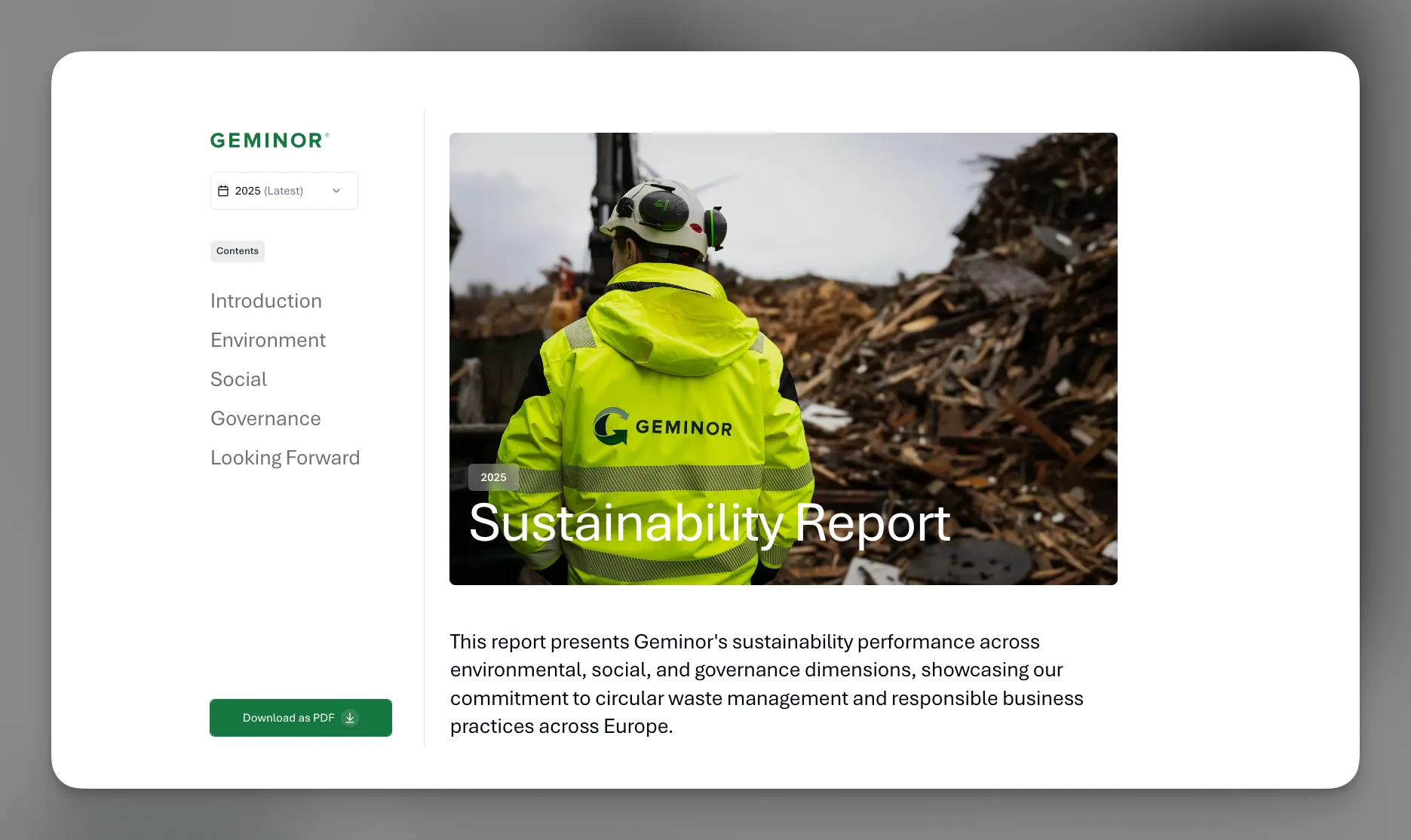
A different kind of reporting year
Geminor handled 2.14 million tonnes of waste across nine countries in 2025, down from 2.34 million in 2024. The decline was driven mainly by lower RDF volumes, reflecting a milder winter and reduced energy demand. As CEO Håvard Framnes notes in the report, lower volumes did not mean lower complexity. Regulation, documentation and traceability requirements all advanced.
The report itself reflects that shift. Following the February 2024 omnibus changes, Geminor is exempt from CSRD reporting through 2025. Rather than scaling back, the company used the exemption to refocus: aligning with the UN Sustainable Development Goals and the VSME standard, and prioritising metrics it can measure and influence directly.
Measuring what matters
The most significant change in 2025 sits behind the scenes. Geminor strengthened its data infrastructure, pulling verified metrics from its Gemisoft system into Power BI dashboards used both for the report and for day-to-day monitoring at hubs and offices. The result is a tighter, more reliable grip on the numbers.
That improvement is visible in the emissions data, and it requires context. Reported Scope 1 and 2 emissions rose to 2,237 tCO₂e in 2025, up from 1,246 tCO₂e. The increase reflects more complete measurement rather than weaker performance: stronger automation and reporting controls closed previous data gaps, while a Danish hub returned to full operation after a 2024 fire and a larger office opened in Warsaw. Geminor’s stated priority is accuracy over a flattering figure, with Scope 3 transport emissions now being built through Gemisoft Green on a project-by-project basis, in line with RED III.
From strategy to practice
Three developments showed the direction in practical terms. Geminor supported Sweden’s first electric RDF import transport, delivering imported fuel to Borås Energi och Miljö with DFDS using electric trucks for the final road leg. It became fuel supplier to Carbon Centric’s Rakkestad facility, among the world’s first full-scale carbon capture plants at a waste incineration site, with capacity to capture around 10,000 tonnes of CO₂ a year. And it launched its R&D programme as a commercial service, documenting fossil CO₂ content, plastic share and non-combustible fractions for customers.
The R&D function was formalised in 2025 as a dedicated team of four, running multi-year projects that connect waste composition to carbon outcomes across the value chain. This is the polluter-pays principle made operational.
The numbers behind the year
More than 98% of waste handled was diverted from landfill. Energy recovery of residual waste generated roughly 6.1 TWh of usable energy, enough to power around 405,000 Nordic households. Energy recovery accounted for 86% of treated volume, recycling 11%, and landfill 2.5%. Recycled material rose 18.5% year on year to 243,000 tonnes. On governance, Geminor completed full recertification of its ISO 9001, 14001 and 45001 systems, valid to 2029, and achieved PEFC certification for the first time.
Looking to 2026
The forward agenda is set by regulation moving closer to daily operations. ETS pricing on fossil carbon in Scandinavian waste-to-energy markets and RED III compliance both take effect, raising the value of exactly what Geminor spent 2025 building: traceability, fossil-content measurement and documented quality control. The company aims to publish its next report within the first quarter of 2026, so it lands while still relevant to a fast-moving market.
Read our sustainability report here: